I have finally managed to take my first steps in flipping my German Year 9 lessons. These are my experiences so far.
Firstly - why bother?
This is a beginner "express" course, with 2 lessons per week. Not a lot of time, and I wanted to maximise my use of class time. I want to do more speaking, and have time to do more interesting reading tasks, and also have the time to support them with extended writing.
Although some are good at learning vocabulary, some are not, and I wanted to promote more active ways of learning vocabulary, and nudge them into using sites such as quizlet.com, which I had used with great success in class.
This class also has some very able linguists who are desperate for more stimulation, and will willingly go away and learn things for themselves, and I wanted a way to give them links and to push them forwards.
How did I set it up?
Until my exam classes go on study leave, I have limited time, but this class can't wait till mid-May. So, for the initial stages, I have used a combination of edmodo and quizlet.
Edmodo - Edmodo looks like facebook, works a bit like facebook, but is designed for schools. It's pretty easy to use (with the help of this wonderful guide to Edmodo), and if the pupils add in their email address, the lost password issue is also less of a headache. For me, I have the chance to share files and documents, links to quizlet and other useful sites, but most importantly, I have the ability to set quizzes to check whether they had understood and learnt the work and I can make them do something active with the learning they do.
Quizlet- flashcard games on the computer, complete with pronunciation to learn vocabulary.
Step-by-step
I got the pupils to join Edmodo, after talking about behaviour online and getting them to sign a code of conduct form which I made - which turned out to be important. With Edmodo looking like facebook, the lines between a "school" site and "fun" site were blurred, and a couple of pupils needed reminding. There is also a setting to allow the teacher to moderate all posts before they are published. I have opted for this.
We did the first Edmodo lesson together, and I showed them the link to their learning homework on quizlet, and told them and messaged them on Edmodo to learn the words first with quizlet and then do the quizzes. In my head this made perfect sense. What happened? Well, many completely ignored that instruction and simply did the quizzes, meaning that they got low scores. Luckily, because we were in class, we discussed in the plenary why that hadn't worked. The instant feedback from the quiz when they saw their score is something the pupils really liked, and they looked at which answers they got wrong, and I could hear some really good comments, such as "I didn't put the endings on the neuter adjectives" or "I've forgotten my capital letters".
They were set loose with a homework to do a similar thing - use quizlet.com to learn the names of clothes and then use the Edmodo quizzes to test whether they knew the vocabulary and to get more practice on adjective endings which we had been practising in class, and which I suspected were not fully secure.
The result
The quiz scores were really mixed, but it sparked a few interesting reactions. Several pupils, and not necessarily the "keen" pupils sent me direct messages to say that they didn't understand a certain aspect of the topic, could we go over it again. Some asked questions which showed they had completely the wrong idea. These pupils were showing a sense of responsibility for their own learning and a degree of reflection which was new and encouraging.
The planning for the next lesson was therefore tightly based around the results I had seen from Edmodo. Rather than having to find out during the next lesson that the pupils were not sure about adjectival endings, I had been able to see this in advance, and save myself some time, and pupils had been able to ask questions without losing face in class.
The boys who had done well were "experts" at various stations in the breakout space, and their job was to help the other pupils get to grips with the adjective endings for masculine nouns etc. They took this role very seriously, and I was then able to reward them with school merits and badges on Edmodo. This took the first 20 mins, and meant we could then do some more rewarding speaking and writing work based on what we wear at the weekend.
There were some issues with access to the internet. Some pupils only had a tablet, and the Edmodo app didn't allow them to do the quizzes, and one boy quietly came and told me that he only had a rubbish computer. I have a week till my next lesson with this class, so he has arranged to do some of his work one lunchtime. It's not perfect, but I bet he will still spend more time on the vocabulary than with a standard vocab list.
Initial conclusions
This allows me to be more responsive to the pupils, and it has nudged them towards taking more responsibility, and I think the boys respond well to the format of Edmodo, and are more open to asking questions. It did allow me to circulate and talk to the pupils, and the boys who were "experts" also felt they understood the rules better after explaining them and helping others. The language which I heard from the boys in the rest of the lesson also convinced me it is another tool in the box which is worth exploring. I intend to flip one lesson each week. I will keep you posted!
Wednesday, 2 April 2014

Thursday, 13 March 2014
Learning for the GCSE German controlled assessment
How many times do hear statements like this?
"I'm good at revision, I just go blank when I go into the exam" or maybe
"It won't go in. I can't learn it"
The constant battle to help pupils learn for the controlled assessment goes on and on. We are also battling against panic and bad revision technique. It boils down to 3 things: they don't understand the language they are trying to use, they use limited strategies which aren't really fit for purpose, and they don't review the learning they have done so far to see if it has worked. This then translates into the following disasters:
1. In an attempt to get the best grade possible, lots of pupils resort to either using impressive looking phrases from worksheets or texts which they don't understand, or they use the dreaded google translate, believing that these things are the magic keys to the kingdom. Some of this comes from them not having faith in the language that they know, and believe that mysterious phrases which look impressive must be better than what they can come up with on their own. Oh, and it's faster. Job done.
2. Despite all efforts to help them in class to learn strategically, they ignore all these strategies in favour of "just reading through" because it's easier.
3. They try to learn too much too fast, ending up in them learning nothing properly.
4. They rarely test themselves to whether they have, in fact, learnt any of it, meaning that they're blissfully unaware that it hasn't worked.
5. If they do test themselves, they don't actually do anything about the weak bits that they have found.
6. They try to use complex phrases without really understanding them or having a "feel" for them - especially subordinating conjunctions such as "weil" in German, where the verb gets sent to the end.
7. They try to learn it parrot-fashion without really knowing what they're saying. Are we the teachers to blame here? I do get exasperated, and sometimes I do say, "Well, you've just got to learn it." I wonder how that is translated in the teenage brain.
Certainly, websites such as www.textivate.com help, although that has now disappeared behind a pay-wall. I'm sure there are others around that you can suggest.
How do you get pupils to try to slow down, really look at the work, and improve their understanding of their work? I teach all boys, and most of them are in a rush to finish and tick the work off their lists. I certainly don't have all the answers, but here are a couple of things I've done recently. Nothing spectacular, but I thought I would share.
End of topic test
Obvious, really, but I've been guilty of being in a rush, and assuming they would learn it during their revision. Um -no! I like to test those key structures that I know they'll need, as well as key words. If they know these already, they're getting there. The difference between "meine Familie" and "mit meiner Familie" - they need to know this. Have they really understood? Pick up the problems and deal with them before starting the task.
Breaking down their learning into 3 phases:
1. words
2. small phrases
3. sentence / paragraph level
This seems to give them focus
*Top 20 difficult words*
This is my favourite. I ask pupils to pick out their top 20 difficult words, whether that's for spelling or for meaning, and I ask them to write a list in English and German.
This works a treat, especially with the complacent ones who simply want to get on and "just learn" it, because suddenly they realise that they don't know what "feierlich" means, and..oh ..what does that mean again?
Why 20 words? It's a manageable number, it's not too scary, and gives them a do-able revision list.
Highlight the complex phrases
The highlighters come out, and they highlight their complex phrases. I get them to test themselves and each other, both on meaning and on correct German. They take that pretty seriously.
Emphasis on communication rather than parrot-fashion
I then get them to choose 10 key content words from a paragraph, and get them to practise communicating their points, rather than doing it word-for-word.
Finally, I tell them that to get a good GCSE they need
Adjectives
Links especially WEIL
Opinions and reasons
Tenses - past, present, future, conditional
*UPDATE*
This got quite a response on twitter, with other members of the wonderful #mfltwitterati contributing their ideas. Here is a summary:
"I'm good at revision, I just go blank when I go into the exam" or maybe
"It won't go in. I can't learn it"
The constant battle to help pupils learn for the controlled assessment goes on and on. We are also battling against panic and bad revision technique. It boils down to 3 things: they don't understand the language they are trying to use, they use limited strategies which aren't really fit for purpose, and they don't review the learning they have done so far to see if it has worked. This then translates into the following disasters:
1. In an attempt to get the best grade possible, lots of pupils resort to either using impressive looking phrases from worksheets or texts which they don't understand, or they use the dreaded google translate, believing that these things are the magic keys to the kingdom. Some of this comes from them not having faith in the language that they know, and believe that mysterious phrases which look impressive must be better than what they can come up with on their own. Oh, and it's faster. Job done.
2. Despite all efforts to help them in class to learn strategically, they ignore all these strategies in favour of "just reading through" because it's easier.
3. They try to learn too much too fast, ending up in them learning nothing properly.
4. They rarely test themselves to whether they have, in fact, learnt any of it, meaning that they're blissfully unaware that it hasn't worked.
5. If they do test themselves, they don't actually do anything about the weak bits that they have found.
6. They try to use complex phrases without really understanding them or having a "feel" for them - especially subordinating conjunctions such as "weil" in German, where the verb gets sent to the end.
7. They try to learn it parrot-fashion without really knowing what they're saying. Are we the teachers to blame here? I do get exasperated, and sometimes I do say, "Well, you've just got to learn it." I wonder how that is translated in the teenage brain.
Certainly, websites such as www.textivate.com help, although that has now disappeared behind a pay-wall. I'm sure there are others around that you can suggest.
How do you get pupils to try to slow down, really look at the work, and improve their understanding of their work? I teach all boys, and most of them are in a rush to finish and tick the work off their lists. I certainly don't have all the answers, but here are a couple of things I've done recently. Nothing spectacular, but I thought I would share.
End of topic test
Obvious, really, but I've been guilty of being in a rush, and assuming they would learn it during their revision. Um -no! I like to test those key structures that I know they'll need, as well as key words. If they know these already, they're getting there. The difference between "meine Familie" and "mit meiner Familie" - they need to know this. Have they really understood? Pick up the problems and deal with them before starting the task.
Breaking down their learning into 3 phases:
1. words
2. small phrases
3. sentence / paragraph level
This seems to give them focus
*Top 20 difficult words*
This is my favourite. I ask pupils to pick out their top 20 difficult words, whether that's for spelling or for meaning, and I ask them to write a list in English and German.
This works a treat, especially with the complacent ones who simply want to get on and "just learn" it, because suddenly they realise that they don't know what "feierlich" means, and..oh ..what does that mean again?
Why 20 words? It's a manageable number, it's not too scary, and gives them a do-able revision list.
Highlight the complex phrases
The highlighters come out, and they highlight their complex phrases. I get them to test themselves and each other, both on meaning and on correct German. They take that pretty seriously.
Emphasis on communication rather than parrot-fashion
I then get them to choose 10 key content words from a paragraph, and get them to practise communicating their points, rather than doing it word-for-word.
Finally, I tell them that to get a good GCSE they need
Adjectives
Links especially WEIL
Opinions and reasons
Tenses - past, present, future, conditional
*UPDATE*
This got quite a response on twitter, with other members of the wonderful #mfltwitterati contributing their ideas. Here is a summary:
- Textivate got a well-deserved big thumbs up from many, and is a great way of managing the active learning. Other active learning ideas:
- @JaneJaneheg suggested memorizenow.com
- Other IT-based ideas from @kec974 were cueprompter and visioprompt
- @Langwitch, @missmaclachlan and several others make good use of mini-whiteboards, getting the pupils the gradually erase words and take the support away, and this also forces them to break things down into chunks
- Post-its with 1 side in the MFL and the other side in English was suggested by @zaragozalass
- @rhwilko has started making them do an English version of what they have prepared. She finds that this also helps them see if their language is too basic
- Others tweeted about discouraging script writing to avoid the pitfall of mindless learning, but maximising the time to practise with a list of key vocab and verbs.
- @SJBarnes suggesting speaking to the drama dept about techniques
Saturday, 8 February 2014
What is IT Lieracy in 2014?
I've been teaching now since 1998, which in technology terms is a lifetime ago. I still remember doing IT training sessions on "how to use Word" alongside older staff members who struggled with the very basics. Those days are a long time away! I've always prided myself on being able to do what I needed to do with computers, without being an expert. When smartboards came along, and powerpoint became a day-to-day necessity, I learnt how to use it, I've used all the IT tools that have come my way, and I've congratulated myself on being at least in the game, if not leading the pack. I'm doing a blog, aren't I?
Well, now I'm not too sure I am still keeping up, and it's made me wonder what IT competency means for teachers and aspiring teachers. It feels to me like the number of programmes, websites and apps which I need to be confident with have exploded in recent years. So, if we accept that we need more than Word and Powerpoint, what else do we need to consider?
Bob Harrison (@bobharrisonset) has put together a quiz to help you think about exactly that, and this was my first step in thinking about this whole area, and gives much food for thought. Watching the tweets from the people at #ililc4 has also made me wonder about my future priorities, and how fast I need to adapt. Here are my additional thoughts.
Managing your classes - Excel
A good teacher knows his/her pupils - their names, quirks, what makes them tick, AND what they need to progress, and that means data. It never occurred to me when I was training. However, there's no escaping data, and it can be a powerful tool if you don't allow it to rule your life - which brings me to my achilles heel. Excel allows you to track your pupils, identify trends, and isolate particular groups through the cunning use of filters. Now, in our school we use SIMS for data, but I feel like I only use the equivalent of the little toe of either programme. I was very envious of a fellow member of the #mfltwittterati who tweeted about his use of excel to manage data, whereas because I use it so badly, it takes me an age to do anything. It really feels like "me no speaky excel". as the formulas especially completely baffle me. He made the point that it was one of his pupils who showed him how to set it up, and it helps him immensely. This has to be part of your armoury.
Use your VLE
As astonishing as it may sound, our school has only just got a VLE, but the benefits are huge - the ability to help pupils have reference to materials, the ability to set homework. It is a great resource, and you should make full use of it.
Social Media and flipping classrooms
I teach German and French. The internet is a powerful tool, which has the potential to connect people, which means being able to get pupils to speak with, read blogs from and write to other people. As my pupils have assured me, writing letters is very last-century, and even emails are incredibly clunky. They also belong to a generation that teach themselves how to play the guitar from youtube. We need to be able to tap into this, so this means...
Ipads
The prospect of our school getting ipads is some way away, but many schools do have them, and their user-friendliness is much praised. @joedale is a source of much information. Just as ipads and iphones / smartphones become part of everyday life, so we need to think about how we can use them. Ignoring them isn't really an option.
Commercial websites and fragmentation of the market
Here's my problem. I have a tiny departmental budget, and many of the commercial websites are simply out of my reach. As attractive as their offers are, I can't take them up.
The development of what's on offer happens at such a bewildering rate, that I don't know how durable many of these developments are. When it was just Microsoft Office, it meant that although you needed to adapt to the latest generation, you didn't need to worry about whether the materials you had developed would simply become unusable. Just as I consider getting to grips with google docs, someone moots the possibility that they may be obselete in a couple of years. Seriously, I would welcome advice.
My priorities?
1. excel
2. blogs
3. google docs
4. edmodo
5. keeping my sanity
One thing at a time, and keep getting advice from my tweeps. Keep experimenting, keep being positive.
Well, now I'm not too sure I am still keeping up, and it's made me wonder what IT competency means for teachers and aspiring teachers. It feels to me like the number of programmes, websites and apps which I need to be confident with have exploded in recent years. So, if we accept that we need more than Word and Powerpoint, what else do we need to consider?
Bob Harrison (@bobharrisonset) has put together a quiz to help you think about exactly that, and this was my first step in thinking about this whole area, and gives much food for thought. Watching the tweets from the people at #ililc4 has also made me wonder about my future priorities, and how fast I need to adapt. Here are my additional thoughts.
Managing your classes - Excel
A good teacher knows his/her pupils - their names, quirks, what makes them tick, AND what they need to progress, and that means data. It never occurred to me when I was training. However, there's no escaping data, and it can be a powerful tool if you don't allow it to rule your life - which brings me to my achilles heel. Excel allows you to track your pupils, identify trends, and isolate particular groups through the cunning use of filters. Now, in our school we use SIMS for data, but I feel like I only use the equivalent of the little toe of either programme. I was very envious of a fellow member of the #mfltwittterati who tweeted about his use of excel to manage data, whereas because I use it so badly, it takes me an age to do anything. It really feels like "me no speaky excel". as the formulas especially completely baffle me. He made the point that it was one of his pupils who showed him how to set it up, and it helps him immensely. This has to be part of your armoury.
Use your VLE
As astonishing as it may sound, our school has only just got a VLE, but the benefits are huge - the ability to help pupils have reference to materials, the ability to set homework. It is a great resource, and you should make full use of it.
Social Media and flipping classrooms
I teach German and French. The internet is a powerful tool, which has the potential to connect people, which means being able to get pupils to speak with, read blogs from and write to other people. As my pupils have assured me, writing letters is very last-century, and even emails are incredibly clunky. They also belong to a generation that teach themselves how to play the guitar from youtube. We need to be able to tap into this, so this means...
- class blogs, such as www.kidblog.org
- skype
- twitter for giving links and information
- google docs and google forms
- dropbox and wikis
- edmodo - I haven't tried it yet, but it is on my list of things to do before the end of this academic year.
- Apps such as Explain Everything or Show Me or powtoon to allow you to put together videos/presentations that pupils can watch at home
- apps and websites for recording audio - voki.com, audioboo
- video conferencing possibilities such as google hangout
- quizlet.com for making flashcard memory games
Ipads
The prospect of our school getting ipads is some way away, but many schools do have them, and their user-friendliness is much praised. @joedale is a source of much information. Just as ipads and iphones / smartphones become part of everyday life, so we need to think about how we can use them. Ignoring them isn't really an option.
Commercial websites and fragmentation of the market
Here's my problem. I have a tiny departmental budget, and many of the commercial websites are simply out of my reach. As attractive as their offers are, I can't take them up.
The development of what's on offer happens at such a bewildering rate, that I don't know how durable many of these developments are. When it was just Microsoft Office, it meant that although you needed to adapt to the latest generation, you didn't need to worry about whether the materials you had developed would simply become unusable. Just as I consider getting to grips with google docs, someone moots the possibility that they may be obselete in a couple of years. Seriously, I would welcome advice.
My priorities?
1. excel
2. blogs
3. google docs
4. edmodo
5. keeping my sanity
One thing at a time, and keep getting advice from my tweeps. Keep experimenting, keep being positive.
Sunday, 19 January 2014
Carousel
This week I did a carousel lesson for the first time in aaaages. An old idea, yes, but still effective. My poor Year 10s had been hit with a lot of grammar recently as we did the perfect tense in detail for the first time. Auxiliary verbs, participles, word order - ouch! we needed a change of pace, change of scenery, and carousel lessons serve this purpose perfectly.
Why have I avoided them?
Managing the logistics
It can be messy, and I have struggled in the past to get the timings of the activities right. Timings are everything.
Supervising and getting the learning right
Carousels mean that the pupils have to get on on their own. Fine if they are well-motivated, but what about the lazy ones or the more switched off pupils? How to keep them learning and moving things on. And, of course - can they make progress in this lesson? There also still needs to be a very clear purpose to the learning. Defining the learning objectives, rather than being distracted by the lovely activities is sometimes harder than you think.
I already do groupwork, so what's the deal?
Although I do groupwork or pairwork most lessons,this type of lesson, if you exclude the plenary at the end, has the pupils in charge of each activity for the whole lesson, including reading the instructions, working out the activity. The change in the use of the room, and the change of format also keeps the pupils on their toes, and allows you to do things from a slightly more unusual perspective.
Things that have worked for me
Changing things up
It's meant to be a change and I try to give a boost to problem solving / speaking / vocab building in these kind of lessons. For example, we had spent a long time in previous lessons focusing on getting our verbs right, but what about the other bits of the sentence? They needed to be built up too. Listening on a laptop rather than as a class is also a valuable thing to do, as it gives them control.
Engaging their curiosity
One group had a carefully wrapped "present" to unpack, and they then needed to remember each others "presents", along the lines of "I went to market and I bought.." - the combination of something to rummage around in with a challenge meant that they enjoyed this and got stuck in. This allowed them to teach themselves new vocabulary whilst practising a key structure - in this case "For Christmas I got...Ryan got.."
Challenges / competitions
How many...can you find? This is easy to mark and you can get a scoreboard easily up-and-running. It gets them going, plus it means it is easy to oversee, and pick up those who might be sitting back. One group had a "word scatter" where they had to build as many sentences as they could. Each member had to fill in a sheet with the team name on, so no passengers here. I teach in an all boys' school, and their competitive spirit gets the better of them. Another had to find as many "haben" verbs and "sein" verbs and adjectives as possible in a reading text. Another had a dictionary skills task to do.
Planning one less activity than you think you need
I always try to pack too much in, so plan a little less to make sure that you have taken into account movement time. This meant that this last time, I had 2 versions of each station going. It worked better, and leads me onto the last point...
A Plenary which ties it all together
This is essential, and should really try to assess the learning which has gone on. Allow yourself enough time to do this, and scale down the carousel if necessary.
Why have I avoided them?
Managing the logistics
It can be messy, and I have struggled in the past to get the timings of the activities right. Timings are everything.
Supervising and getting the learning right
Carousels mean that the pupils have to get on on their own. Fine if they are well-motivated, but what about the lazy ones or the more switched off pupils? How to keep them learning and moving things on. And, of course - can they make progress in this lesson? There also still needs to be a very clear purpose to the learning. Defining the learning objectives, rather than being distracted by the lovely activities is sometimes harder than you think.
I already do groupwork, so what's the deal?
Although I do groupwork or pairwork most lessons,this type of lesson, if you exclude the plenary at the end, has the pupils in charge of each activity for the whole lesson, including reading the instructions, working out the activity. The change in the use of the room, and the change of format also keeps the pupils on their toes, and allows you to do things from a slightly more unusual perspective.
Things that have worked for me
Changing things up
It's meant to be a change and I try to give a boost to problem solving / speaking / vocab building in these kind of lessons. For example, we had spent a long time in previous lessons focusing on getting our verbs right, but what about the other bits of the sentence? They needed to be built up too. Listening on a laptop rather than as a class is also a valuable thing to do, as it gives them control.
Engaging their curiosity
One group had a carefully wrapped "present" to unpack, and they then needed to remember each others "presents", along the lines of "I went to market and I bought.." - the combination of something to rummage around in with a challenge meant that they enjoyed this and got stuck in. This allowed them to teach themselves new vocabulary whilst practising a key structure - in this case "For Christmas I got...Ryan got.."
Challenges / competitions
How many...can you find? This is easy to mark and you can get a scoreboard easily up-and-running. It gets them going, plus it means it is easy to oversee, and pick up those who might be sitting back. One group had a "word scatter" where they had to build as many sentences as they could. Each member had to fill in a sheet with the team name on, so no passengers here. I teach in an all boys' school, and their competitive spirit gets the better of them. Another had to find as many "haben" verbs and "sein" verbs and adjectives as possible in a reading text. Another had a dictionary skills task to do.
Planning one less activity than you think you need
I always try to pack too much in, so plan a little less to make sure that you have taken into account movement time. This meant that this last time, I had 2 versions of each station going. It worked better, and leads me onto the last point...
A Plenary which ties it all together
This is essential, and should really try to assess the learning which has gone on. Allow yourself enough time to do this, and scale down the carousel if necessary.
Saturday, 18 January 2014
Catching the drifters - update
I wrote here about catching the pupils who were drifting, and the missed opportunities I wanted to avoid. I wanted to give you an update on how this worked.
What I did - the Challenge
I asked the pupils I had identified from an assessment to stay behind. I asked them to rate their confidence in German, their concentration levels, and to identify 3 things they could do to boost their confidence and their work. These were then the targets that they used to assess their progress at the end of each lesson for 2 weeks. They had a simple sheet to use each lesson, and the sheet also posed the question: "Do I need to do anything differently next lesson?". I targeted my questioning more sharply, and reminded pupils, and that was all that was needed.
How did it go?
what I would do differently
As usual, I made it too complicated. I had kept the target sheets, which meant it was too complicated to manage. Next time, I will get the sheets stuck in their books at the back: simpler and more discreet.
What really worked
The vast majority of the pupils took it seriously, and most were able to say straight away why they hadn't performed as well ("I didn't revise, Miss"; "I talk too much"; "I don't understand verbs"). Asking them to assess themselves rather than berate them for underperforming in the test proved to be a bridge.
They were noticed
This is the most heart-breaking aspect. These pupils suddenly felt they were no longer invisible. They felt empowered, and because they knew they couldn't get away with doing the minimum, many of them upped their game. Keeping the nature of the intervention positive and encouraging meant that they bought into it.
Re-assessing
I got them to review their position at the end of 3 weeks, and most had made good progress, and crucially, they had gained a "can-do" attitude. Next week, we have the January exams, and the proof will be be in the pudding
It identified pupils who were actually causes for concern
There were 2 pupils in the group who, on closer inspection, showed more worrying signs of lack of engagement, and more serious problems. I hope that, by catching them earlier than I would normally, I may be able to put more active interventions in place, and stop the rot...maybe.
Impact for the whole class?
I have noticed an improvement in the atmosphere in the whole class - more focus, a more positive attitude.
From my point of view
I sharpened up my questioning, and I feel I know all of my pupils better. I think it has improved me as a teacher, and apart from the breaktime I lost at the beginning and the end of the process, there was little extra effort involved. Lots of impact for little effort.
I haven't worked out how to put documents on a blog yet, so here is the link to the TES
What I did - the Challenge
I asked the pupils I had identified from an assessment to stay behind. I asked them to rate their confidence in German, their concentration levels, and to identify 3 things they could do to boost their confidence and their work. These were then the targets that they used to assess their progress at the end of each lesson for 2 weeks. They had a simple sheet to use each lesson, and the sheet also posed the question: "Do I need to do anything differently next lesson?". I targeted my questioning more sharply, and reminded pupils, and that was all that was needed.
How did it go?
what I would do differently
As usual, I made it too complicated. I had kept the target sheets, which meant it was too complicated to manage. Next time, I will get the sheets stuck in their books at the back: simpler and more discreet.
What really worked
The vast majority of the pupils took it seriously, and most were able to say straight away why they hadn't performed as well ("I didn't revise, Miss"; "I talk too much"; "I don't understand verbs"). Asking them to assess themselves rather than berate them for underperforming in the test proved to be a bridge.
They were noticed
This is the most heart-breaking aspect. These pupils suddenly felt they were no longer invisible. They felt empowered, and because they knew they couldn't get away with doing the minimum, many of them upped their game. Keeping the nature of the intervention positive and encouraging meant that they bought into it.
Re-assessing
I got them to review their position at the end of 3 weeks, and most had made good progress, and crucially, they had gained a "can-do" attitude. Next week, we have the January exams, and the proof will be be in the pudding
It identified pupils who were actually causes for concern
There were 2 pupils in the group who, on closer inspection, showed more worrying signs of lack of engagement, and more serious problems. I hope that, by catching them earlier than I would normally, I may be able to put more active interventions in place, and stop the rot...maybe.
Impact for the whole class?
I have noticed an improvement in the atmosphere in the whole class - more focus, a more positive attitude.
From my point of view
I sharpened up my questioning, and I feel I know all of my pupils better. I think it has improved me as a teacher, and apart from the breaktime I lost at the beginning and the end of the process, there was little extra effort involved. Lots of impact for little effort.
I haven't worked out how to put documents on a blog yet, so here is the link to the TES
Sunday, 8 December 2013
Adapting Pie Corbett's Talk for Writing for MFL or What we can learn from primary schools
In many of the wonderful teachmeet /show and tell/ pedagoo events I have attended in the last 12 months, I have been reminded of the great work that primary schools do with their pupils, and how little awareness I have of them as a secondary school teacher.
At #pedagoowonderland I was lucky enough to be able to attend a workshop led by @RachelOrr about Pie Corbett's Talk 4 Writing and how she used it in her primary school, and there were a lot of great ideas. This is the first time I've hear of Pie Corbett, and this website explains it in more detail. The aspects of it which caught my attention were the following:
Using actions to help pupils think about punctuation and connectives. My favourites? Salute the capital letter, the finger click for a comma, a karate chop and clap for an exclamation mark. There are some pupils in secondary school for whom these kinaesthetic shortcuts in MFL could really benefit. If I have understood it correctly, the approach is about internalising the language, and embedding the language in a fun, memorable way. I liked the actions for certain storytelling words or connectives. Teaching these with an action would enable the class to stay in the target language.
The approach had 3 stages:
Imitate - the pupils learn the story with actions, internalising the language
Innovate - whilst "hugging" the original, changing certain aspects
Invent - using the starters and connectives for their own story
The pupils would use storytelling "maps" with pictures and symbols. I liked this idea as well.
Whilst we do this to a certain extent in MFL, I have never tried to do a whole story like this, and I would worry about spending so long on imitation. However, this has a real impact on literacy in primary school. Why shouldn't it help some of our pupils who really struggle with MFL? Food for thought, maybe?
Many thanks again to @RachelOrr for a thought-provoking session.
At #pedagoowonderland I was lucky enough to be able to attend a workshop led by @RachelOrr about Pie Corbett's Talk 4 Writing and how she used it in her primary school, and there were a lot of great ideas. This is the first time I've hear of Pie Corbett, and this website explains it in more detail. The aspects of it which caught my attention were the following:
Using actions to help pupils think about punctuation and connectives. My favourites? Salute the capital letter, the finger click for a comma, a karate chop and clap for an exclamation mark. There are some pupils in secondary school for whom these kinaesthetic shortcuts in MFL could really benefit. If I have understood it correctly, the approach is about internalising the language, and embedding the language in a fun, memorable way. I liked the actions for certain storytelling words or connectives. Teaching these with an action would enable the class to stay in the target language.
The approach had 3 stages:
Imitate - the pupils learn the story with actions, internalising the language
Innovate - whilst "hugging" the original, changing certain aspects
Invent - using the starters and connectives for their own story
The pupils would use storytelling "maps" with pictures and symbols. I liked this idea as well.
Whilst we do this to a certain extent in MFL, I have never tried to do a whole story like this, and I would worry about spending so long on imitation. However, this has a real impact on literacy in primary school. Why shouldn't it help some of our pupils who really struggle with MFL? Food for thought, maybe?
Many thanks again to @RachelOrr for a thought-provoking session.
#pedagoo wonderland differentiation
This year I have 2 sets where I have some real high-fliers biting my hand off for new and challenging language, who are in the same class as some kids who find learning a language a bit of a mystery. Differentiation is therefore VERY close to my heart, and occupying a lot of my time. Here are some of the ideas from the fabulous #pedagoowonderland. I'm sharing the ideas that I found interesting and this is my first step in processing them.

This picture above is Rebecca from the Science dept at Joseph Swan demonstrating her idea for tic-tac-toe stylee homework. Design a grid with tasks at different levels. The core task, which everyone has to do is in the centre. The pupils then have a choice of tasks to finish off their "line". I thought this was a lovely idea.


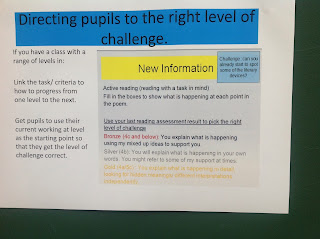
I agree with the thinking behind this. It becomes too easy for pupils simply to lean on the support sheet crutch.
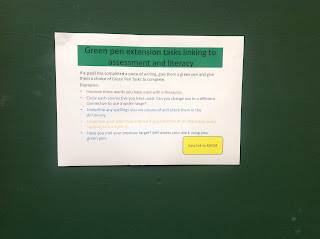
I'm not crazy about the idea of giving out more pens just to be able to show outsiders where improvements have been made, but the idea of having extension tasks where you ask them to reflect, for example, on the connectives they have used and to improve them is a nice one.
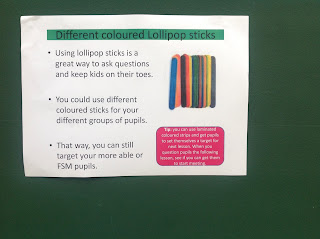
 I liked the idea of having cards which you can colour code to support the types of differentiation you need for that particular lesson without having to provide another handout.
 Teaching different roles, and getting the passengers to take on more of a leadership role can be a powerful way to develop their learning skills.
These ideas will help, but they are certainly not the whole story. I also went to @teamtait's workshop on flipped learning. Our school has recently got its act together and got a VTLE, a decade after the rest of the country. I think this has real potential for my classes, but I will blog about this in the New Year, as that needs a lot more processing.
A big thank you to Andrea Kirton who ran this differentiation workshop, and to all at Joseph Swan Academy who worked so hard to put on such a thought-provoking, mojo-boosting day.
What I liked about this idea was that it very much starts from where the pupils are.
This picture above is Rebecca from the Science dept at Joseph Swan demonstrating her idea for tic-tac-toe stylee homework. Design a grid with tasks at different levels. The core task, which everyone has to do is in the centre. The pupils then have a choice of tasks to finish off their "line". I thought this was a lovely idea.
Differentiated challenge cards -I'm thinking of using this for connectives and how to extend your language.
I agree with the thinking behind this. It becomes too easy for pupils simply to lean on the support sheet crutch.
I'm not crazy about the idea of giving out more pens just to be able to show outsiders where improvements have been made, but the idea of having extension tasks where you ask them to reflect, for example, on the connectives they have used and to improve them is a nice one.
I really liked the tip about using laminated strips rather than lollipops so that pupils can set themselves a target for next lesson, which means that you can then tailor your question to the target the pupil has set themselves. I'm a big fan of exit passes, and this combines exit passes with lollipop sticks.
These ideas will help, but they are certainly not the whole story. I also went to @teamtait's workshop on flipped learning. Our school has recently got its act together and got a VTLE, a decade after the rest of the country. I think this has real potential for my classes, but I will blog about this in the New Year, as that needs a lot more processing.
A big thank you to Andrea Kirton who ran this differentiation workshop, and to all at Joseph Swan Academy who worked so hard to put on such a thought-provoking, mojo-boosting day.
Subscribe to:
Posts (Atom)